Mother of champion weightlifters, short in stature: big in personality
The lights of Mill Road gleam a little less brightly tonight after the death of Bessie “Betty” Morgan at the age of 92, one of the oldest residents in the area.
Betty, who came from the well-known Silverman family, lived in Perowne Street for 68 years, setting up home there in 1952. She was a well known figure in the area, a familiar face in many of the shops and cafés until moving into the St Georges Court care home earlier this year. She died in October after developing pneumonia.
One of eight children, Betty was born in the city on 12 July 1928, to Samuel and May Silverman. Her late brother Charlie established the Silverman’s Office Furniture company, which still trades in the city while sister Doreen, aged 94, still lives in Fen Ditton.
In 1952, Betty married Ken, who worked as a carpenter for British Rail, and gave birth to two sons, David in 1964 and Tony in 1969.
Although a mere 4ft 7inches tall, what Betty lacked in height she more than made up for with her big personality and strong work ethic. And it was as a mother that Betty thrived, showing extraordinary devotion and commitment to support “her boys” in their sporting careers. Both excelled in weightlifting and Betty was determined that each would achieve his potential. She supported them at events but beyond that normal parental help, she offered crucial financial help at one point working three separate jobs so that David and Tony could have the time to train when financial support for top athletes was not available.
David Morgan inducted into the Welsh Sports Hall of Fame, 2013. From left: Welsh weightlifter Daruis Jokarzadeh (6′ 9″) bronze medal in junior world championships; Welsh long jumper Lyn Davies, 1964 Olympic gold medal; David Morgan and mother Betty. Photo courtesy Jonathan Wilson.
And that devotion and commitment paid off: Tony became the youngest British senior champion at age 15, completed in the 1992 Olympics and then won a bronze in the 1998 Commonwealth Games in Kuala Lumpur.
David twice came fourth in the Olympic Games in Los Angeles (1984) and four years later in Seoul. And is the only athlete ever to win gold at five different Commonwealth games. He competed in three Olympic Games, won various world championships and broke multiple world records. His sporting achievements culminated in the award of the MBE in this year’s New Year’s Honours list. And Betty could not have been more proud when David told her the news.
But David and Betty’s trip to Buckingham Palace in June was, of course, cancelled in the wake of the Covid-19 pandemic.
Betty with son David. Photo Jonathan Wilson
Sadly husband Ken died in 1994 of leukaemia, aged 69, but he lived long enough to see many of the successes of his sons.
In later life, Betty loved dressing in bright colours and always wore high-heeled boots.
In April 2004, Betty decided to slim-down her wardrobe. A neighbour, jokingly printed a sign.
She enjoyed her garden, butterflies and flowers, the Cambridge Botanic Gardens being one of her favourite haunts. Betty was also a proud grandmother to Tony’s children, Katie and Tom.
Betty with (L-R) Perowne Street neighbour Monica Smith, granddaughter Katie and son Tony enjoying the Perowne Street party in 2009
Betty loved the Perowne Street/Emery Street residents’ street parties. She regularly had breakfast at the Salvation Army, lunch at Ditchburn Place and afternoon tea in the Grafton Centre or elsewhere in the city centre.
Betty’s funeral will be held at Cambridge Crematorium (West Chapel) on Wednesday 11th November 2020, at 2pm but, but given Covid restrictions, attendance will be strictly limited to family and close friends. For further information, please contact Rosalind or David Morgan on 07813 592479 or 01223 562595.
David and Tony intend to host a more fitting event to celebrate their mother’s life once the Covid pandemic has passed – hopefully an all-singing-all-dancing street party in Perowne Street – and are planning to adopt a bench in her honour in the Botanic Gardens.
This post was amended on Monday 2nd November to correct the title to 1928-2020.
Local poet and neighbour, Carol Ann Wood, has written a poem to celebrate Betty Morgan’s life in Perowne Street.
Click the image to view/download a printable PDF of this poem.
Mill Road Bridges welcomes this consultation, which follows years of campaigning, nationally and locally. Parliamentarians of all parties, on the Transport Committee, including Cambridge’s MP, Daniel Zeichner, have been looking at this problem for some time. This could herald major improvements to shopping along Mill Road.
We are not the only group in Cambridge to welcome this consultation. Cambridge Cycling Campaign (CamCycle) posted…
We very much welcome the government’s consultation on dealing with pavement parking. This is the culmination of many years of campaigning by national transport groups and disability groups, as well as local campaigning by us and others.
Parking of cars on pavements is a scourge which can be seen all around the city. It makes it difficult for people walking, using buggies, using wheelchairs and mobility scooters, and people with visual impairments. It damages pavements, and in general treats other road users with a lack of courtesy. It causes injuries and deaths of people walking, particularly children, as a result of drivers trying to park their cars on the pavement.
Many national and regional newspapers carried this Press Association report, pointing out…
Disabled people and parents are particularly affected by parked cars blocking their way…
Recent research from charity Guide Dogs indicated that 32% of people with visual impairments and 48% of wheelchair users are less keen to go out on their own because of antisocial pavement parking.
New research by Guide Dogs shows the wide variety of people affected by pavement parking, and the everyday impact it has on their lives. Nine in ten disabled people, including those with sight loss, mobility scooter users, and parents or carers with children said they had been affected by pavement parking.
Many towns and cities were not designed to accommodate today’s high traffic levels; and at some locations, especially in residential areas with narrow roads and no driveways, the pavement is the only place to park without obstructing the carriageway. However, irrespective of whether pavement parking is deemed necessary, there are inherent dangers for all pedestrians; being forced onto the carriageway and into the flow of traffic. This is particularly difficult for people with sight or mobility impairments, and those with prams or buggies. While resulting damage to the pavement and verges is uppermost, a trip hazard, maintenance and personal injury claims are also a cost to local authorities.
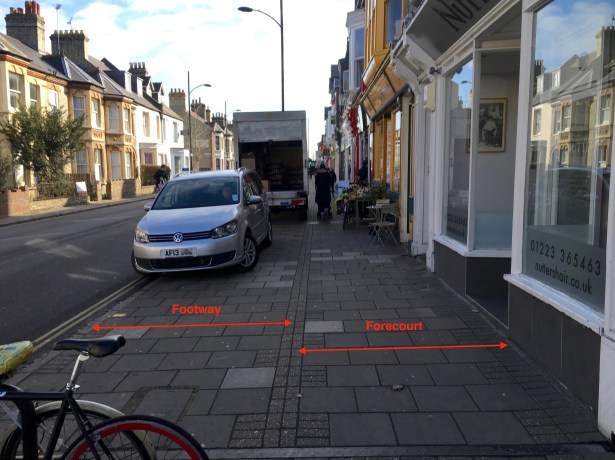
Whilst some sections of Mill Road’s pavements look wide, a large part of what you think is the pavement may be the shops’ forecourt, which they can use for outdoor stalls, seating or displays.
Businesses are allowed to use the forecourt area for sales, displays or seating
When cars, vans and lorries pull onto the pavement, it leaves little room for people to walk past. It’s even harder if you’re pushing a child’s buggy, or using a wheelchair. And should you have to pull your toddler out of the way of somebody’s car?
But isn’t pavement parking already illegal?
Since 1974, parking on pavements, with certain exceptions, has been prohibited in Greater London… [with] Exemptions at specific locations … indicated by traffic signs… The reverse applies elsewhere in England, where parking on pavements and verges is permitted unless specifically prohibited by a … Traffic Regulation Order (TRO). The DfT is currently … looking at how … to make TROs easier to implement, including for pavement parking.
The offence of unnecessary obstruction of the highway, which includes the road as well as the pavement … allow[s] proceedings to be brought by the police … where parking on the pavement, in such a way as to cause obstruction, is … avoidable.
Understandably, CamCycle complain that “The police have failed to take action to address pavement parking,” however, as has been pointed out elsewhere on this website…
Cambridgeshire County Council have had powers to deal with this for over nine years.
Councils with civil parking enforcement powers (including Cambridgeshire County Council) were given ‘special authorisation’ in February 2011 by the (then) Parliamentary Under Secretary of State, Norman Baker, to prohibit parking on footways and verges, wherever they considered it necessary. This would be through a traffic regulation order (TRO, or ETRO).
Part 6 of the Traffic Management Act 2004 allows most types of parking contraventions to be enforced by local authorities [in our case Cambridgeshire County Council – Ed] as a civil matter, instead of as a criminal matter by the police. enforcement ceases to be the responsibility of the police and becomes the responsibility of the local authority…
Civil Enforcement Officers (CEOs)… place Penalty Charge Notices (PCNs) on offending vehicles [and] the local authority retains the proceeds from the penalty charges, which are used to finance the enforcement…* Any surpluses must be used for prescribed purposes only.
❌ Cambridgeshire County Council would be under no obligation to do anything. The County have had powers to use TROs to deal with pavement parking for over nine years – powers they have not used, despite there being no cost to council tax payers. Option 1 would, effectively, mean no change to having to dodge cars, taxis, vans and lorries on Mill Road’s pavements.
❌ The same issues apply. Option 2 is simply an extension to the powers which Cambridgeshire County Council have been ignoring for nearly a decade. Would anything change?
✅ The effect of a national pavement parking prohibition would be to reverse the current situation. Cambridgeshire County Council would be obliged to enforce the ban, and would also have to decide where to allow pavement parking. (And, if drivers ignore the ban, the PCN revenue may even help to fill a few potholes.)
We can see why CamCycle write…
We encourage residents to respond positively to the government’s consultation and to support option 3 … In the meanwhile, we continue to ask why the police are not doing more to keep pavements clear for pedestrians.
Nothing would change about the parking arrangements along the narrow sections of (eg) Cockburn Street, Thoday Street and Catharine Street, unless residents asked for change.
Local authorities would be expected to decide where pavement parking remained necessary and to introduce the necessary exemptions and to place traffic signs and bay markings to indicate where pavement parking is permitted. The bay could be placed completely on the pavement where there is sufficient width, or part on / part off.
What would change, is that it would become unlawful to pull any vehicle onto any of Mill Road’s pavements – and the same across the whole of Cambridge – except for specific exemptions. These would include:
fire brigade purposes
police purposes
ambulance purposes
delivery, collection, loading or unloading of goods to, or from any premises, in the course of business; where this cannot reasonably be carried out without the vehicle being parked on a pavement
You are welcome to leave (polite) comments below, to engage with the local community, but these will not be seen by the DfT or become part of the consultation.